Futures Prop Firm Payouts Explained: Why Getting Paid Shouldn't Wait Until the End
Most traders focus on passing an evaluation. But when does the actual payout happen? Discover how 18th Street Trading connects performance, fixed phase payouts, earned progression, and ultimately live trading capital.

Every futures trader understands the importance of profitability.
But profitability and getting paid are not necessarily the same thing.
A trader may successfully complete an evaluation, demonstrate consistent performance, and satisfy a firm's risk requirements without immediately becoming eligible to receive a payout.
That is because futures proprietary trading firms use different payout structures.
Some distinguish between evaluation and funded stages. Others impose additional requirements before withdrawals become available. Payout eligibility, withdrawal frequency, profit splits, and account progression can all vary depending on the program.
For serious traders comparing firms, the question should extend beyond how much profit an account can theoretically generate.
When does performance become a payout, and what must the trader accomplish to receive it?
At 18th Street Trading, that question was central to the design of the firm's current progression model.
Rather than requiring traders to complete the entire qualification process before becoming eligible for a payout, 18th Street provides a fixed payout after each successfully completed simulated phase.
The principle is straightforward:
Performance → Payout → Progression → Live Capital.
The Difference Between Profit and a Payout
One of the most important distinctions in futures prop trading is the difference between simulated account profits and money actually payable to a trader.
During a simulated qualification phase, the account balance represents notional capital.
The displayed profits do not constitute cash held in a brokerage account on behalf of the trader.
They are performance results generated within the firm's simulated environment.
A payout is different.
A payout represents compensation the trader becomes eligible to receive after satisfying the applicable requirements.
Understanding that distinction is essential because an advertised account size, a simulated profit target, and an actual payout are three separate figures.
They should never be confused.
At 18th Street Trading, Phases 1 through 4 operate in a simulated environment. The phase payouts are real, fixed amounts payable when the trader successfully completes the requirements.
The Live account, reached after Phase 4, operates differently and uses actual capital with exchange execution.
Why 18th Street Pays Traders During Progression
18th Street Trading was built around the idea that greater responsibility should be earned through demonstrated performance.
But progression should also create meaningful milestones along the way.
A trader who successfully completes Phase 1 has demonstrated the published standard once.
A trader who completes Phase 2 has demonstrated it again.
By Phase 3, the record has become more substantial.
By Phase 4, the trader has completed the same qualification standard four separate times.
Each successful phase represents an additional demonstration of discipline, consistency, and risk management.
18th Street connects those milestones directly to fixed payouts.
The trader does not need to wait until the final simulated phase to become eligible for compensation.
Each completed phase carries its own payout.
Once that payout is requested and completed, the trader begins the next phase from a fresh simulated balance.
This creates a clear relationship between demonstrated performance and advancement.
How Much Does 18th Street Trading Pay?
18th Street offers four Funded Futures plan sizes: $25,000, $50,000, $100,000, and $150,000.
Every plan begins at Phase 1.
Every plan follows the same four-phase progression.
The payout amounts increase with the plan size.
The current fixed payout schedule is:
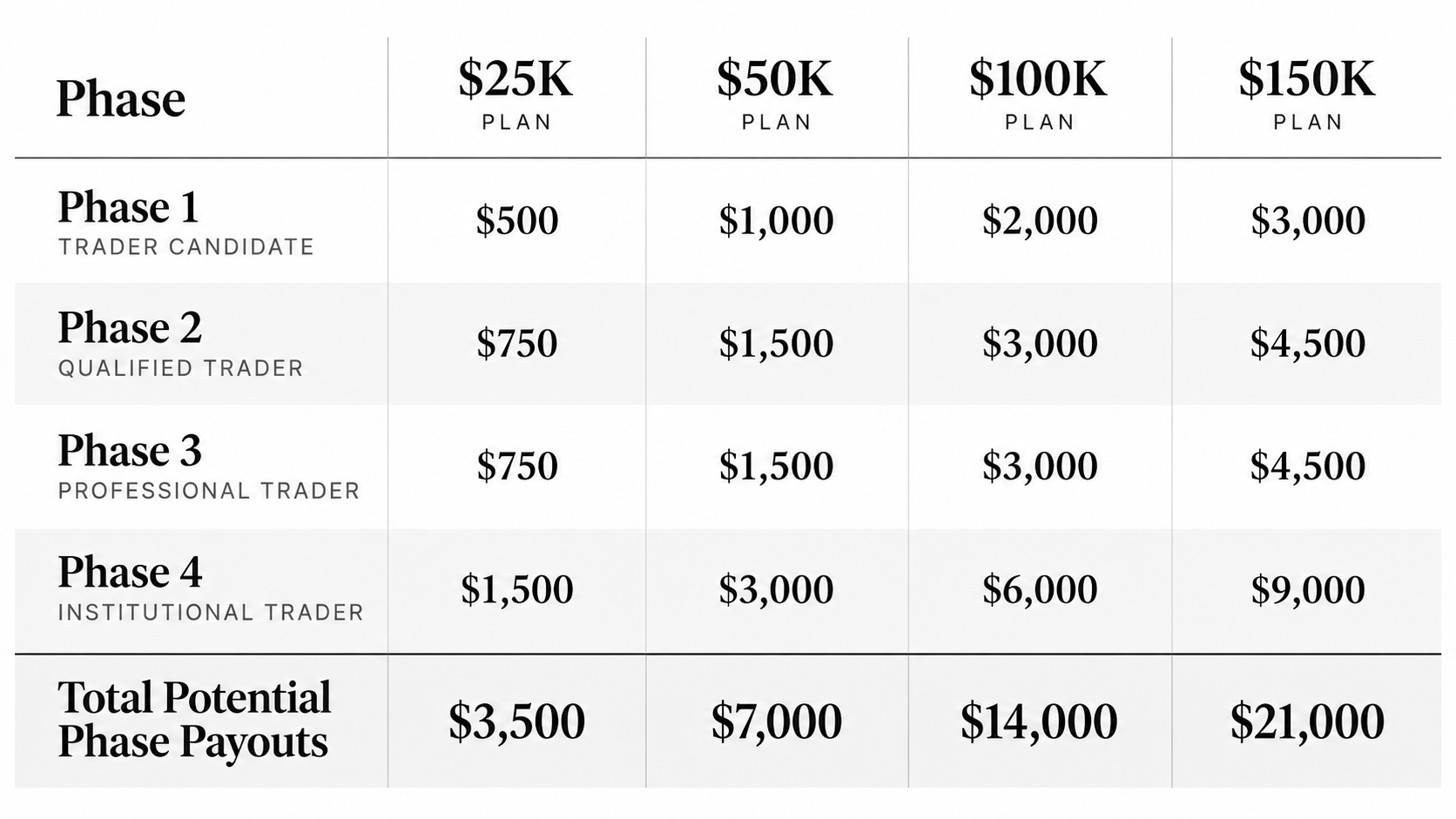
These are fixed payouts associated with successfully completing the corresponding phases. They are not guaranteed earnings, and the total amounts assume successful completion of all four phases.
An important feature of the structure is that the Phase 1 payout exceeds the original plan fee at every account size.
For example, the $50,000 plan carries a one-time fee of $525.
Successfully completing Phase 1 makes the trader eligible for a $1,000 payout, subject to verification and the published requirements.
The payout is not a refund of the plan fee.
It is compensation associated with successfully completing the first phase.
That distinction matters because the trader must first meet the qualification requirements.
What Must Happen Before a Payout?
At 18th Street Trading, reaching the profit target alone does not complete a phase.
Every simulated phase requires the trader to satisfy three core performance conditions:
A 9% profit target.
A 5% end-of-day trailing maximum loss.
A 25% consistency requirement.
The phase must also be completed within its 60-day limit.
For example, the $100,000 plan has a $9,000 profit target.
But a trader who reaches $9,000 through one unusually large trading session may still need to continue trading until the 25% consistency requirement is satisfied.
That requirement measures the trader's best trading day against total accumulated profit.
It is not a breach rule.
If the ratio exceeds 25%, the trader can continue trading within the published rules until the requirement is met.
Only after all phase requirements have been satisfied does the fixed payout become available.
The payout must then be requested and completed before the trader advances to the next phase.
This approach makes the payout a consequence of completing the full standard, rather than simply reaching a number.
How Are Phase Payouts Processed?
Transparency around payout processing is just as important as transparency around payout amounts.
18th Street Trading currently supports payouts through cryptocurrency, Rise, and store credit.
Supported cryptocurrency payout options include USDC on ERC20, ETH on ERC20, and BTC.
Rise provides an alternative payment pathway that can facilitate transfers to a trader's bank account.
Store credit can be applied toward another 18th Street plan.
Payouts are usually processed within 24 hours on business days, although processing times are not guaranteed and may depend on verification and payment-method requirements.
Before requesting the first payout, traders must complete Know Your Customer verification and the required Trader Agreement.
These requirements are disclosed in the firm's published FAQ and Qualification specifications.
The objective is to make the payout process understandable before a trader begins.
Why Phase Payouts Are Fixed
A common question is why 18th Street uses fixed phase payouts rather than paying traders a percentage of every dollar generated in the simulated environment.
The answer comes down to the purpose of the qualification process.
The objective of each phase is to demonstrate that the trader can meet a defined performance standard.
It is not to encourage unlimited simulated profit accumulation.
A trader who exceeds the phase profit target does not receive a larger phase payout simply because the simulated profit number is higher.
The payout remains fixed.
That structure keeps the focus on meeting the standard rather than maximizing simulated gains after the objective has already been satisfied.
The trader's opportunity for greater responsibility comes through progression.
And progression must be earned.
What Happens After All Four Phases?
Successfully completing Phase 4 changes the nature of the relationship.
The trader has now demonstrated the qualification standard four times.
The simulated progression is complete.
The trader advances to the Capital Partner designation and a Live account.
This is where an important distinction becomes necessary.
The Live account is not simply the original simulated account with a different label.
It uses actual capital and executes trades directly on the exchange.
The Live account balances are smaller than the corresponding simulated plan sizes because they represent real capital rather than notional balances.
For the $25,000 plan, the Live account begins with $3,000.
For the $50,000 plan, the Live account begins with $6,000.
For the $100,000 plan, the Live account begins with $12,000.
For the $150,000 plan, the Live account begins with $18,000.
Those balances are published before a trader purchases a plan.
There should be no ambiguity about the difference between simulated qualification capital and live trading capital.
How the 90% Live Profit Split Works
Once a trader becomes a Capital Partner, the fixed phase payout structure no longer applies.
Instead, the trader receives 90% of profits generated under the Live account arrangement.
The Live account also operates under a different risk structure.
There is no additional profit target.
There is no consistency requirement.
There is no time limit.
The maximum loss is fixed at 50% of the Live account's starting balance.
For example, the $6,000 Live account associated with the $50,000 plan carries a fixed $3,000 maximum loss.
Live execution introduces real-market conditions, including slippage, partial fills, liquidity variation, and actual capital exposure.
Those conditions are materially different from simulated qualification.
The Live account currently operates on Rithmic, with a $62 monthly platform and market-data fee deducted from the account balance.
The first Live withdrawal may be requested on demand. Subsequent withdrawals are available once every 30 calendar days, subject to the published terms.
The distinction between the two environments is intentional.
During qualification, traders are compensated through fixed phase payouts.
Once live, compensation is tied to actual trading profits.
Why Payout Structure Matters When Choosing a Futures Prop Firm
A large advertised account balance does not necessarily mean a trader has access to an equally large amount of risk capital.
A high advertised profit split does not necessarily mean a trader can immediately request a withdrawal.
And passing an evaluation does not necessarily mean the trader has reached live market execution.
These distinctions matter because traders should evaluate the complete economic structure of a firm.
What is the initial cost?
When does payout eligibility begin?
What conditions must be satisfied?
Are payouts fixed or percentage-based?
Is the account simulated or live?
What additional fees apply?
How frequently can withdrawals be requested?
What happens after qualification?
At 18th Street Trading, these questions are addressed through a published progression model that connects performance to fixed payouts and ultimately to live capital.
The structure will not appeal to every trader.
Some may prefer a different qualification model or payout arrangement.
But traders should be able to understand exactly what they are entering before committing.
That is part of the institutional standard.
A Professional Record Should Lead Somewhere
The futures proprietary trading industry has made it easier than ever to access simulated trading environments.
But access alone does not create a professional trading career.
A meaningful progression model should establish what is expected, how performance is evaluated, when compensation becomes available, and what greater responsibility looks like.
At 18th Street Trading, those principles are built into the structure.
Every trader begins at Phase 1.
Every phase carries the same standard.
Every successfully completed phase provides a fixed payout.
And completing all four creates the opportunity to trade actual capital.
Performance → Payout → Progression → Live Capital.
The objective is not simply to reward one profitable trading session.
It is to recognize the development of a record.
A record built through consistency.
A record built through discipline.
And a record that earns greater responsibility over time.
Institutional Standard. Professional Traders.
18th Street Trading offers $25,000, $50,000, $100,000, and $150,000 futures plans built around four simulated phases, fixed payouts at every successfully completed stage, and a defined progression toward Live capital.
One starting plan fee.
No activation fees.
No recurring subscription during qualification.
No purchasable shortcuts through progression.
Earn the phase. Receive the payout. Build the record. Progress.
Explore the full qualification structure and discover what it takes to become a Capital Partner at 18th Street Trading.
Apply for Capital Access.
Futures trading involves substantial risk and is not suitable for every trader. Past performance is not necessarily indicative of future results. Phases 1–4 operate in a simulated environment using notional capital. Fixed phase payouts are conditional on successfully meeting the applicable requirements and completing verification. Live trading involves actual capital and real-market execution. Participation does not guarantee successful completion, payouts, profits, or progression to a Live account.
For educational purposes only. Nothing in this article is financial, investment, tax or legal advice. Trading futures involves substantial risk and is not suitable for every investor. See our Risk Disclosure.
Founder of 18th Street Trading, a futures proprietary trading firm built on one standard: consistency, disciplined risk management and earned progression.